

Image Details
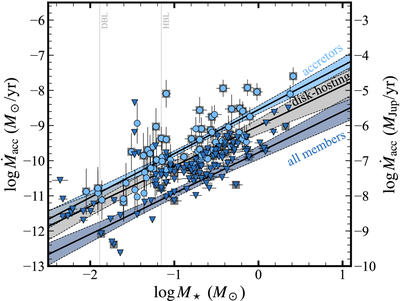
Caption: Figure 10.
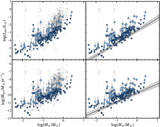
Mass accretion rate as a function of stellar mass for IC 348 members. Filled circles denote accretion detections, and triangles indicate upper limits. The accretors-only fit (light blue) yields ﹩\mathrm{log}\dot{M}\,={\alpha }_{{\rm{\det }}}\mathrm{log}({M}_{\star }/{M}_{\odot })+{\beta }_{{\rm{\det }}}﹩ with ﹩{\alpha }_{{\rm{\det }}}=1.25﹩ and ﹩{\beta }_{{\rm{\det }}}=-8.55﹩, while the fit including all members (dark blue) yields αall = 1.16 and βall = −9.77. The systems with primordial thick disks from C. J. Lada et al. (2006) are highlighted as gray squares, of which 67% (44/66) are classified as accretors. This subsample of 66 systems yields αdisk-hosting = 1.13 and βdisk-hosting = −9.02.
Other Images in This Article
Show More
Copyright and Terms & Conditions
© 2026. The Author(s). Published by the American Astronomical Society.

