

Image Details
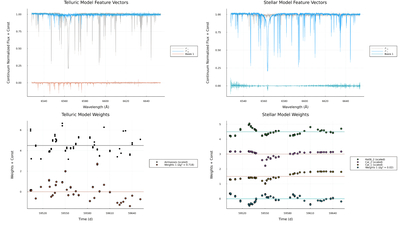
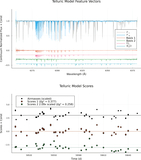
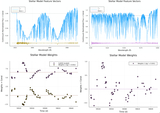
Caption: Figure 9.
SSOF model of order 93 for HD 26965 which identifies H-alpha variation. Top left: The telluric and stellar templates are shown above in gray and blue while the telluric feature vector is shown below (orange). This vector is dominated by changing H2O transmission between observations. Bottom left: the observed air mass (black) and telluric feature scores (orange) as a function of time. The H2O signal is not correlated with air mass but clearly identified in multiple orders (see Figure 8). Top right: the telluric and stellar templates are shown above in gray and blue while the stellar feature vector is shown below (turquoise). This vector is dominated by the changes in H-alpha. Bottom right: the stellar feature scores as a function of time. The scores for the H-alpha feature vector (turquoise) are correlated with the H-alpha variation measured by NEID’s DRP (green), although SSOF’s scores are a bit noisier due to the inclusion of the entire order. Some NEID measurements of CaI lines are also shown. The residuals between v⋆,93 and ﹩{v}_{\star }^{{\mathtt{SSOF}}}﹩ are shown in Figure 11.
Other Images in This Article

Show More
Copyright and Terms & Conditions
© 2026. The Author(s). Published by the American Astronomical Society.

