

Image Details
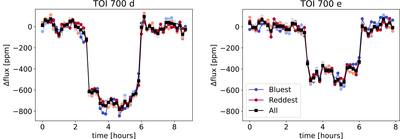
Caption: Figure 6.
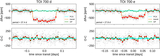
We subdivide our light-curve data into five wavelength bins, each contributing 20% of the total flux. In terms of wavelengths, these bins correspond to 0.60–1.02 (labeled “bluest”), 1.02–1.21, 1.21–1.42, 1.42–1.74, and 1.74–2.83 μm (labeled “reddest”). The data are also binned to 10 minute intervals in the time axis. In black, we show our white-light curve that includes all wavelengths. Much of the correlated noise appears to be consistent across all wavelengths. Nonetheless, we do observe some chromatic systematics, particularly for the bluest bin, which shows a slope during the transit of TOI 700 e and stronger correlated noise during the transit of TOI 700 d.
Other Images in This Article
Copyright and Terms & Conditions
© 2026. The Author(s). Published by the American Astronomical Society.

