

Image Details
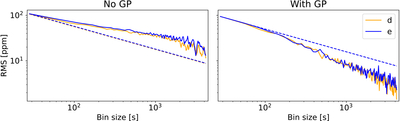
Caption: Figure 5.
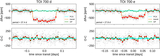
Rms residuals of our light-curve fits at different binning cadences. We analyze the two transits separately, but the results are comparable, with marginally worse performance for e. The dashed lines are a prediction of rms improvement following an empirical white-noise scaling (i.e., the native-cadence rms scaled by ﹩1/\sqrt{N}﹩, where N is the number of points per bin). Without a Gaussian process (GP; left), the binning performs worse than the prediction due to the presence of time-correlated noise (potentially stellar granulation; see text). Unlike the findings of L.-P. Coulombe et al. (2023) for WASP 18 b, we are still unable to recover the white-noise scaling after binning down to cadences longer than an hour. With a GP (right; described in Section 3.1.3), we achieve better precision than we expect from this scaling. While this could indicate overfitting on the part of the GP, it could alternatively suggest that there is also excess noise at high frequencies; therefore, scaling from the achieved rms at the native 27 s sampling cadence would underestimate the achievable precision. We note that if we instead adopt the nominal flux errors from exoTEDRF to calculate our expected rms at the native cadence and scale from this value, the GP model provides excellent agreement with Poisson expectations when binned to cadences equal or longer than the GP length scale.
Other Images in This Article
Copyright and Terms & Conditions
© 2026. The Author(s). Published by the American Astronomical Society.

