

Image Details
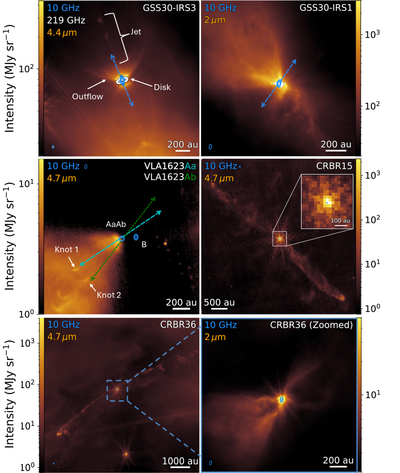
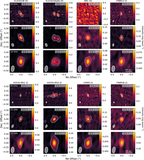
Caption: Figure 4.
Large-scale NIRCam images revealing extended outflows, protostellar jets, and knotlike features on hundreds to thousands of au scales, with each panel showing one of three filters: 2 μm (continuum, scattered light), 4 μm (continuum, scattered light), and 4.7 μm (H2S(9) rotational line). Overlaid ALMA continuum emission (white contours) traces the disk morphology, while VLA 10 GHz continuum (blue contours) traces ionized gas emission, illustrating the connection of these three facilities across multiple spatial scales. Position angles of the 10 GHz morphology are overlaid as blue (GSS30-IRS1, IRS3), cyan (VLA 1623 Aa), and green (VLA 1623 Ab) dashed arrows. Excluding GSS30-IRS1, the NIRCam images use lower data-range limits of 0.75 (CRBR15, CRBR36), 1 (VLA 1623 AaAb), 2 (CRBR36 Zoomed), and 15 MJy sr−1 (GSS30-IRS3). Continuum contours correspond to 5σ, 10σ, 20σ, and 100σ (ALMA) and 3σ, 5σ, 10σ, and 20σ (VLA), with σ = rms as defined in Table E1.
Other Images in This Article
Show More
Copyright and Terms & Conditions
© 2026. The Author(s). Published by the American Astronomical Society.

