

Image Details
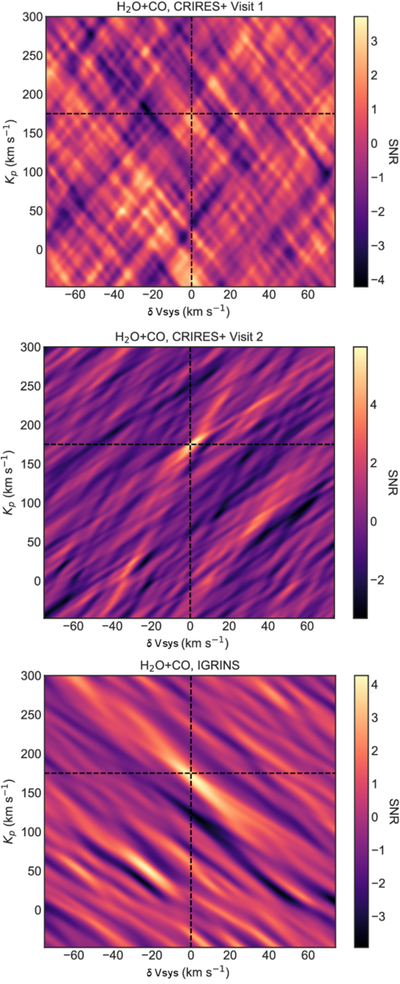
Caption: Figure 6.
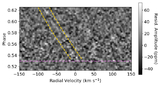
Kp vs. δvsys diagrams for each observation epoch. The CRIRES+ Visit 2 epoch and the IGRINS epoch both exhibit the strongest signal at the planet’s expected location (dashed black lines) and exhibit SNR > 4 at that location, and so we can confidently say that we have detected the planet at these epochs. In the CRIRES+ Visit 1 epoch we do see a signal at the expected position, but it is only at an SNR ∼ 3 and is not the strongest signal we observe, and so we are not able to confidently detect the planet. We therefore proceed in the rest of the analysis only using CRIRES+ Visit 2 and the single IGRINS epoch.
Other Images in This Article

Show More
Copyright and Terms & Conditions
© 2026. The Author(s). Published by the American Astronomical Society.

