

Image Details
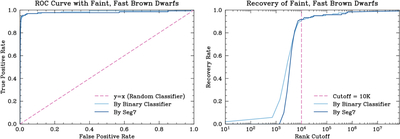
Caption: Figure 6.
Receiver operating characteristic (ROC) curves (left) and recovery rate (right) comparing two methods of ranking sky regions with SMDET output. True positive classifications are of sky regions containing faint, fast brown dwarfs from our sample. False positive classifications are of sky regions that we rejected in our review (Section 4.1) and sky regions that we did not review. The ROC is marginally underestimated because of the latter. Recovery rate increases after rank 1000 because prior ranks consist of false positives and other true positives, such as brown dwarfs, white dwarfs, and low-mass stars. A vertical line shows our examination limit at rank cutoff = 10 K. The binary classifier is a neural network, and Seg7 is a simple metric (Section 4.2).
Other Images in This Article
Copyright and Terms & Conditions
© 2026. The Author(s). Published by the American Astronomical Society.

