

Image Details
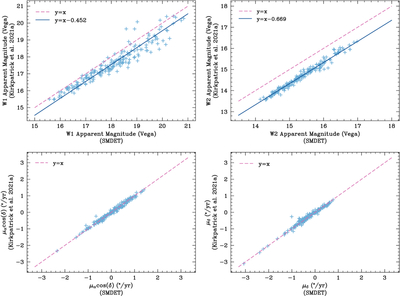
Caption: Figure 7.
Comparisons between SMDET (x-axes) and J. D. Kirkpatrick et al. (2021a, y-axes) photometry (top) and astrometry (bottom). Solid lines show the best-fit linear corrections for SMDET photometry: y = x − 0.452 for W1 and y = x − 0.669 for W2. Dashed lines show y = x for reference. The reference data from J. D. Kirkpatrick et al. (2021a) are more precise, derived from Spitzer IRAC images that are deeper and have better angular resolution than unWISE images. We converted Spitzer IRAC to WISE magnitudes with the relations W1 ≃ (ch1 − 0.78505) × 0.89844−1 and W2 ≃ ch2.
Other Images in This Article
Copyright and Terms & Conditions
© 2026. The Author(s). Published by the American Astronomical Society.

Copyright ©
2026 Astronomy Image Explorer. All Rights Reserved.
