

Image Details
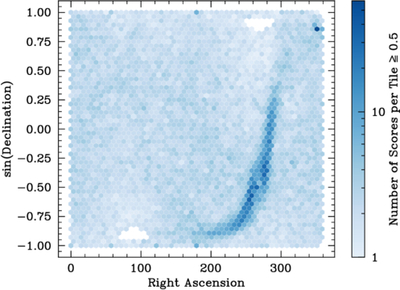
Caption: Figure 5.
Density of 176″ × 176″ sky regions that scored ≥0.50 in our full-sky processing of real unWISE images (Section 4). The axes are in equatorial coordinates: R.A. (degrees) and ﹩\sin (\,\rm{declination}\,)﹩. Six key areas are visible: the Galactic plane centered at ∼265° R.A., the north and south ecliptic poles at 270° and 90° R.A., the north and south celestial poles, and an area in the northern sky surrounding the Cassiopeia A supernova remnant at ∼350° R.A.
Other Images in This Article
Copyright and Terms & Conditions
© 2026. The Author(s). Published by the American Astronomical Society.

Copyright ©
2026 Astronomy Image Explorer. All Rights Reserved.
