

Image Details
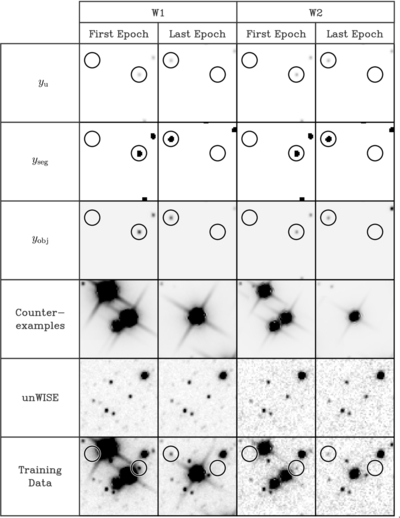
Caption: Figure 1.
First and last images from an example in our training dataset. SMDET input shown in the Training Data row is equal to unWISE + yobj + Counterexamples. yobj is the reproduction of FFOs in the input and ground truth for SMDET output ﹩{\hat{y}}_{{\rm{obj}}}﹩. yseg is the segmentation of the input and ground truth for SMDET output ﹩{\hat{y}}_{{\rm{seg}}}﹩. yu, which we used to construct yseg and as a parameter in loss calculation, is equivalent to yobj except that each object has total flux = 1 DN. First and last positions of one synthetic FFO are circled. Other objects enter or exit the field of view in the time series and are therefore not present at both epochs. We address this when processing unWISE data by overlapping the fields of view of adjacent time series (Section 2.2).
Other Images in This Article
Copyright and Terms & Conditions
© 2026. The Author(s). Published by the American Astronomical Society.

