

Image Details
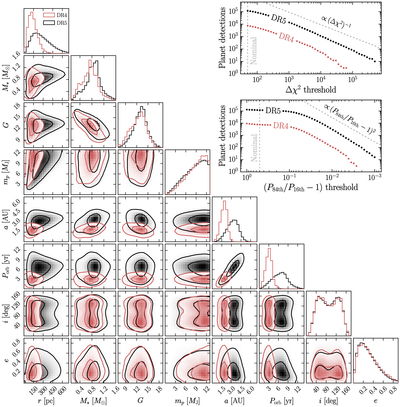
Caption: Figure 12.
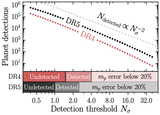
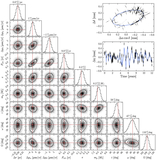
Recovered properties for the 7500 mock Gaia DR4 detections (red) and the 120,000 DR5 detections (black). Contours show the 1σ and 2σ ranges in each 2D distribution, and the histograms show the 1D distributions. The plots in the top right corner show how the number of detections depends on the Δχ2 threshold and the orbital-period precision threshold (see Section 4.3). Most detections will be super-Jupiters on few-astronomical-unit orbits around GKM-type stars within a few hundred parsecs. The longer time span of the DR5 data will dramatically increase Gaia’s search volume, resulting in ∼16 times as many detections as in DR4. Only a subset of the detected planets will have well-constrained masses; we predict that 1900 ± 540 and 38,000 ± 7300 planets will have masses and periods measured to within 20% in DR4 and DR5, respectively (see Section 4.3).
Other Images in This Article
Show More
Copyright and Terms & Conditions
© 2025. The Author(s). Published by the American Astronomical Society.

