

Image Details
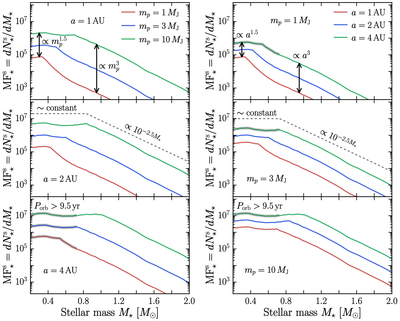
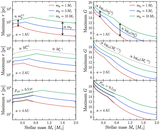
Caption: Figure 6.
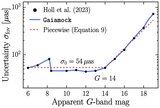
Predictions for the MF of stars that could host a Gaia-detectable planet (MF﹩{}_{\star }^{{{\rm{s}}}}﹩) in DR5. Plots in the left column show MF﹩{}_{\star }^{{{\rm{s}}}}﹩, in units of ﹩{M}_{\odot }^{-1}﹩, vs. stellar mass for a fixed orbital radius and three different choices of planet mass. Plots on the right show MF⋆ vs. stellar mass for planets with a fixed mass and three different choices of orbital radius. As the stellar mass rises, MF⋆ is initially constant before suddenly falling as ﹩1{0}^{-2.5{M}_{\star }}﹩. The transition occurs when the searchable stars cross G = 14, the breakpoint in our model of Gaia’s astrometric precision (see Figure 4). The black arrows illustrate how MF﹩{}_{\star }^{{{\rm{s}}}}﹩ scales with mp and a. Millions of stars could host detectable planets, most of which are less massive than the Sun.
Other Images in This Article
Show More
Copyright and Terms & Conditions
© 2025. The Author(s). Published by the American Astronomical Society.

