

Image Details
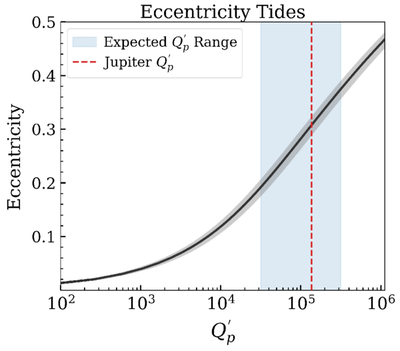
Caption: Figure 10.
Required orbit eccentricity (e) as a function of the modified tidal quality factor (﹩{Q}_{p}^{{\prime} }﹩) for TrES-1 b, assuming eccentricity tides are the dominant mechanism driving orbital decay. The black curve and surrounding gray region show the eccentricity values needed to match the best-fit decay rate of ﹩-7.{1}_{-1.6}^{+\,1.5}﹩ ms yr−1. The shaded blue region represents the theoretically expected range of ﹩{Q}_{p}^{{\prime} }﹩ for HJs (M. M. Mahmud et al. 2023), while the red dashed line marks the estimated value for Jupiter (V. Lainey et al. 2009). The fact that the required eccentricity (e ≳ 0.2) falls well outside observational constraints suggests that eccentricity tides cannot drive orbital decay.
Other Images in This Article
Show More
Copyright and Terms & Conditions
© 2025. The Author(s). Published by the American Astronomical Society.

