Image Details

Choose export citation format:

TrES-1 b: A Case Study in Detecting Secular Evolution of Exoplanet Orbits

  • Authors: Simone R. Hagey, Billy Edwards, Angelos Tsiaras, Aaron C. Boley, Anastasia Kokori, Norio Narita, Pedro V. Sada, Filip Walter, Robert T. Zellem, Napaporn A-thano, Kevin B. Alton, Miguel Ángel Álava Amat, Paul Benni, Emmanuel Besson, Patrick Brandebourg, Marc Bretton, Mauro Caló, Martin Valentine Crow, Jean-Christophe Dalouzy, Marc Deldem, Tõnis Eenmäe, Stephane Ferratfiat, Pere Guerra, Gary Vander Haagen, Ken Hose, Adrian Jones, Yves Jongen, Didier Laloum, Stefano Lora, Alessandro Marchini, Jacques Michelet, Matej Mihelčič, Johannes Mieglitz, Eric Miny, David Molina, Mario Morales Aimar, Raphael Nicollerat, Ivo Peretto, Manfred Raetz, François Regembal, Robert Roth, Lionel Rousselot, Mark Salisbury, Darryl Sergison, Anaël Wünsche, Jaroslav Trnka

Simone R. Hagey et al 2025 The Astronomical Journal 170 .

  • Provider: AAS Journals

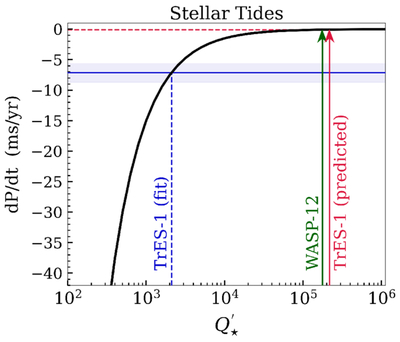
Caption: Figure 8.

The expected orbital period derivative for TrES-1 b under the assumption that stellar tides dominate its orbital evolution, as a function of the modified stellar quality factor ﹩{Q}_{\star }^{{\prime} }﹩. The solid blue horizontal line represents the best-fit orbital decay rate for TrES-1 b, with the shaded region indicating the corresponding 68% credible interval. Three specific values of ﹩{Q}_{\star }^{{\prime} }﹩ are highlighted: (1) the value derived from the best-fit orbital decay rate using Equation (17), (2) the predicted value from the tidal forcing period of the system using Equation (18), and (3) the value inferred for WASP-12, an HJ decaying at ∼30 ms yr−1, from I. Wong et al. (2022).

Other Images in This Article
Show More

Copyright and Terms & Conditions

Additional terms of reuse