

Image Details
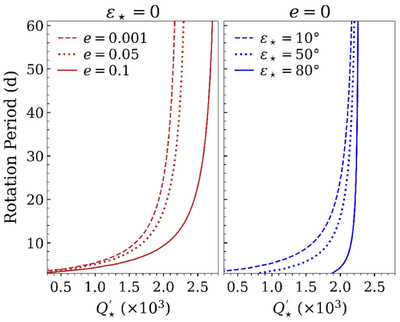
Caption: Figure 9.
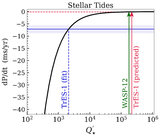
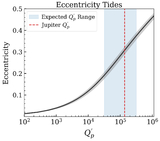
Stellar rotation period as a function of the modified stellar quality factor, ﹩{Q}_{\star }^{{\prime} }﹩, for a scenario in which stellar tides drive orbital decay at a rate of −7.1 ms yr−1. The calculations use the exact expression for decay due to tides in the star (Equation (A1)) for different combinations of stellar obliquity (ε⋆) and orbital eccentricity (e). There is no parameter space in which ﹩{Q}_{\star }^{{\prime} }﹩ falls within the empirically expected range of ﹩1{0}^{5}\lt {Q}_{\star }^{{\prime} }\lt 1{0}^{8}﹩ (K. Penev et al. 2018). Left: the required ﹩{Q}_{\star }^{{\prime} }﹩ for different eccentricities when the stellar obliquity is zero. Right: the required ﹩{Q}_{\star }^{{\prime} }﹩ for different obliquities when the orbital eccentricity is zero.
Other Images in This Article
Show More
Copyright and Terms & Conditions
© 2025. The Author(s). Published by the American Astronomical Society.

