

Image Details
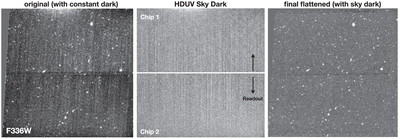
Caption: Figure 4.
The improvement in image quality thanks to the use of a sky dark image in the HDUV data reduction. The left panel shows a single visit of F336W data drizzled using the standard dark frame. Significant residual structure is clearly visible, including severe striping along the readout direction (i.e., hot and cold columns), as well as a significant glow at the upper edge. These can be largely removed with a sky dark. The middle panel represents the corresponding sky dark image computed for the first epoch data of the HDUV in the F336W filter. Such sky dark images are computed for each filter and for the HDUV and CANDELS data separately. They are then subtracted from each corresponding frame before further processing. The right panel shows the improvement in image quality after application of the sky dark on the same F336W visit as in the left panel.
Other Images in This Article
Copyright and Terms & Conditions
© 2018. The American Astronomical Society. All rights reserved.

