

Image Details
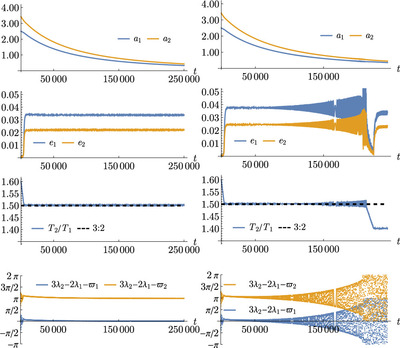
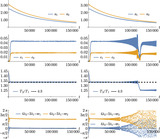
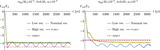
Caption: Figure 5.
Evolution under convergent migration of two planets, with masses m 1 = 3 × 10⁻⁵ M * and m 2 = 5 × 10⁻⁵ M * respectively, near the 3:2 commensurability. The disk has α t = 3.16 × 10⁻⁴, and h = 0.05. Panels on the left and on the right have the same initial conditions, and show, from top to bottom, the evolution of the semimajor axes, eccentricity, period ratio, and resonant angles. All panels make use of Paardekooper et al. (2011)'s torque prescription; instead, panels on the left use Cresswell & Nelson (2008)'s e-damping prescription (Equation (25)), while panels on the right use our modified e-damping prescription (Equation (30)). The modified damping efficiency manifests itself in that, due to the overall less efficient e-damping, the captured resonant state is found at higher eccentricities; moreover, the libration inside the 3:2 resonance becomes overstable in the right panels, leading to an escape from the resonance and a more compact final state.
Other Images in This Article
Copyright and Terms & Conditions
© 2024. The Author(s). Published by the American Astronomical Society.

