

Image Details
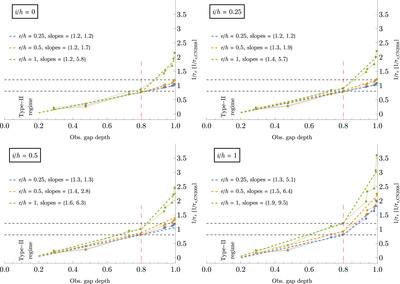
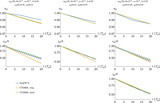
Caption: Figure 3.
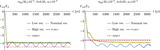
Observed eccentricity damping efficiency vs. observed gap depth for all setups where no vortex emerged. In all panels, the e-damping efficiencies on the vertical axis are normalized by the expected value from Cresswell & Nelson (2008) and are shown for different eccentricities e/h ∈ {0.25, 0.5, 1} by points of different colors joined together by opaque lines. The different panels are for different orbital inclinations, with i/h ∈ {0, 0.25, 0.5, 1}. Two dashed horizontal gray lines indicate, around the expected value in the limit of no gap (to the right in the plots), an error of 20%, which is the typical uncertainty of analytical planet–disk interaction formulas (Paardekooper et al. 2011). For all inclination values, we observe a decrease in e-damping efficiency for deeper and deeper gaps well outside this margin of error, and down to a factor of ∼1/5 less efficient eccentricity damping at the transition from type-I to type-II regimes (gap depths of ≃0.3) as compared to the limit of no gap. The data are well modeled by a double-linear fit that depends on the gap depth, the eccentricity, and the inclination (see Equations (30) and (31)), shown with dashed lines whose color reflects the orbital eccentricity (the slopes for the piecewise fits are given in the legend in the top left corner of each panel).
Other Images in This Article
Copyright and Terms & Conditions
© 2024. The Author(s). Published by the American Astronomical Society.

