

Image Details
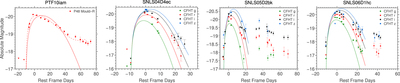
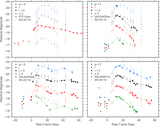
Caption: Figure 21.
Best-fit magnetar models (solid lines) to the light curves of our events. Triangles denote 3σ non-detection upper limits. We use the Inserra et al. (2013) models with an explosion energy of 1051 erg and an opacity κ = 0.2 cm2 gr−1, we fix the explosion dates to the values listed in Table 6, and we restrict the initial spin period Pi to be >1 ms. For PTF10iam the model is not a good fit and requires the lowest allowable initial spin period (1 ms). We perform a fit with no restrictions on the initial period and present it in the dashed line. The SNLS observations are better fit by the models, but all require very low ejecta masses (the best-fit model parameters are listed in Table 10), and are unable to reproduce the late time light-curve behavior.
Other Images in This Article
Show More
Copyright and Terms & Conditions
© 2016. The American Astronomical Society. All rights reserved.

