

Image Details
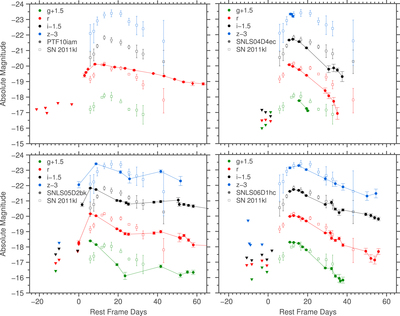
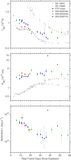
Caption: Figure 9.
Comparison of the light curves of our events (filled symbols and lines) to SN 2011kl (empty symbols; Greiner et al. 2015), an SN that accompanied an ultra-long-duration GRB. Time zero for SN 2011kl is set to the time of the GRB trigger. For our events it is set to the estimated time of explosion (with an offset of 2 days for SNLS04D4ec and 3 days for SNLS06D1hc to improve the match). No brightness matching was applied. PTF10iam is at a substantially different redshift than SN 2011kl (z = 0.109 vs. z = 0.677), so the observed wavelength coverages do not match. SNLS06D1hc, on the other hand, is at a redshift very similar to that of SN 2011kl, and the two events appear almost identical in their light-curve shapes (in each filter), indicating that they may be members of the same class of explosions.
Other Images in This Article
Show More
Copyright and Terms & Conditions
© 2016. The American Astronomical Society. All rights reserved.

