

Image Details
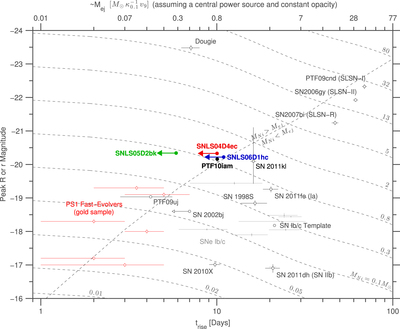
Caption: Figure 8.
Peak magnitude vs. rise time of our events (upper limits for the SNLS rise times) compared to other SNe (see text for references). All comparison data peak magnitudes and rise times are in the observed R or r band. Rise times are in the rest frame of each event. Ejecta mass estimates are normalized to an expansion velocity of 10,000 km s−1 (see text for details, also regarding the calculated nickel masses) and should only be considered approximate. Our events have shorter rise times compared to most SNe and are more luminous than all similarly rapid events except for Dougie, which is a clear outlier in this context. The only event similar to ours is SN 2011kl, which was accompanied by an ultra-long-duration GRB (Greiner et al. 2015). The positions of our events in this phase space require either a very high nickel to ejecta mass ratio or an alternative dominant power source to nickel decay.
Other Images in This Article
Show More
Copyright and Terms & Conditions
© 2016. The American Astronomical Society. All rights reserved.

