

Image Details
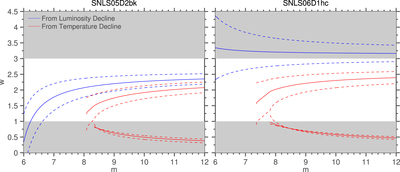
Caption: Figure 19.
Constraints on the values of w and m for SNLS05D2bk (left) and SNLS06D1hc (right) derived from the best-fit power-law decline rates of their bolometric luminosity (blue) and temperature (red). One sigma errors are denoted by corresponding blue or red dashed lines. Two solutions for w exist given a value for m from the temperature decline slope due to the quadratic nature of Equation (10). The gray areas mark the regions outside the allowed values of w by the Svirski et al. (2012) model. For SNLS06D1hc, the values of w are not consistent between the luminosity and temperature decline rates, for any m. For SNLS05D2bk, the values are marginally consistent for large m, and are close to the constant-wind value w = 2.
Other Images in This Article
Show More
Copyright and Terms & Conditions
© 2016. The American Astronomical Society. All rights reserved.

