

Image Details
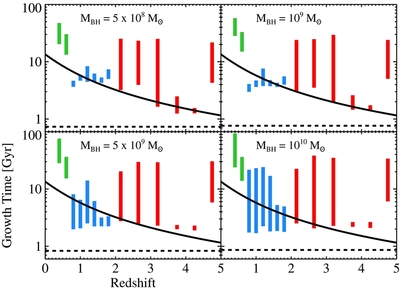
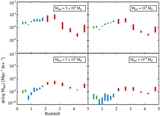
Caption: Figure 15.
Estimated typical time needed for a black hole to grow from a seed mass of
M
seed
BH = 10
6
M
☉ to four different final masses as a function of redshift, assuming a radiative efficiency of
 r
= 0.1 and the typical Eddington ratio for that mass and redshift bin. The solid line marks the age of the universe as a function
of
z, the dashed line marks the growth time assuming
L/
L
Edd = 1, and the rest of the labeling is the same as that in Figure
5. Although the uncertainties are large, the growth times for SMBHs in Type 1 quasars having
M
BH
r
= 0.1 and the typical Eddington ratio for that mass and redshift bin. The solid line marks the age of the universe as a function
of
z, the dashed line marks the growth time assuming
L/
L
Edd = 1, and the rest of the labeling is the same as that in Figure
5. Although the uncertainties are large, the growth times for SMBHs in Type 1 quasars having
M
BH
 5 × 10
8
M
☉ are comparable to or greater than the age of the universe, suggesting an earlier phase of accelerated obscured growth. The
growth times at
z ≲ 0.6 are also longer than the age of the universe, possibly reflecting a shift to fueling by mass loss from evolved stellar
populations.
5 × 10
8
M
☉ are comparable to or greater than the age of the universe, suggesting an earlier phase of accelerated obscured growth. The
growth times at
z ≲ 0.6 are also longer than the age of the universe, possibly reflecting a shift to fueling by mass loss from evolved stellar
populations.
Other Images in This Article
Show More
Copyright and Terms & Conditions
© 2013. The American Astronomical Society. All rights reserved.

