

Image Details
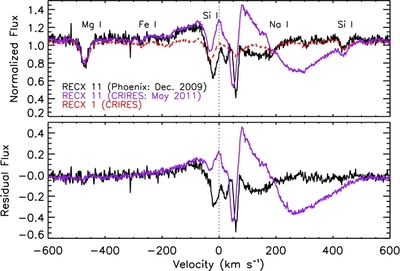
Caption: Figure 3.
He i λ10830 profiles of RECX-1 and RECX-11. Top panel: He i observations of RECX-11 are shown from two epochs largely separated in time by 18 months. RECX-1 is shown for comparison and photospheric lines identified by the Infrared Telescope Facility (IRTF) spectral library are designated (Rayner et al. 2009). RECX-11 shows significant variability between the two observations, including a variable redshifted emission component and a broad, high-velocity redshifted absorption component, characteristic of magnetospheric infall. Bottom panel: He i λ10830 line profiles of RECX-11 after subtraction of the RECX-1 line profile. The Phoenix observation was degraded to the resolution of the CRIRES observations prior to subtraction of the RECX-1 profile. The photospheric lines are cleanly subtracted but the complex nature of the profile remains.
Other Images in This Article
Copyright and Terms & Conditions
© 2011. The American Astronomical Society. All rights reserved.

