

Image Details
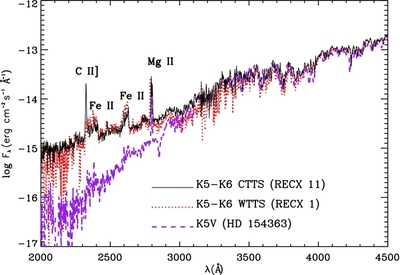
Caption: Figure 1.
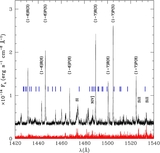
STIS spectra of the WTTS RECX-1 (both north and south components, see Section 2.2), the CTTS RECX-11, and the dwarf standard star, HD 154363. All have K5–K6 spectral types but RECX-1 is no longer accreting while RECX-11 has ongoing accretion (Lawson et al. 2004; Sicilia-Aguilar et al. 2009; Jayawardhana et al. 2006). The spectra of RECX-1 and RECX-11 are remarkably similar, except for the stronger C ii λ2325 line in the CTTS. The Mg ii λ2800 doublet strength is comparable in the three sources (Section 4).
Other Images in This Article
Copyright and Terms & Conditions
© 2011. The American Astronomical Society. All rights reserved.

Copyright ©
2026 Astronomy Image Explorer. All Rights Reserved.
