

Image Details
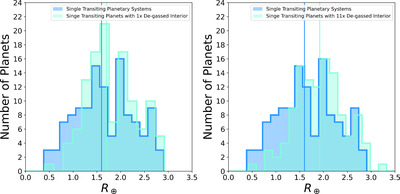
Caption: Figure 7.
Left: histogram of our single-transiting-planet systems (blue) and a histogram of those same planets with a steam atmosphere consisting of 0.27 wt.% of the planet’s mass (aquamarine). We estimate the planets’ mass with the mass–radius relation calculated by Zeng et al. (2019) and the extent of the steam atmosphere with the atmospheric model of Turbet et al. (2020). The blue and aquamarine vertical lines represent the median of the sample. We find with 1 bulk Earth-content of water, including the surface water (the physical oceans) and the amount of water in the mantle,degassed from the interior to form a secondary atmosphere that the radii of these planets are inflated by 0.1 Earth radii, insufficient to explain our observed difference between the single and compact multiple planetary systems. Right: identical to left but for a bulk water content inflated by a factor of 11 relative to the Earth. We find that to reproduce the observed differences between compact multiple planetary radii and single planetary radii through excess degassing from tidal forces, these planets would have to have a bulk water content 11× that of the Earth and for this water to be 100% degassed to form a secondary steam atmosphere.
Other Images in This Article
Copyright and Terms & Conditions
© 2024. The Author(s). Published by the American Astronomical Society.

