

Image Details
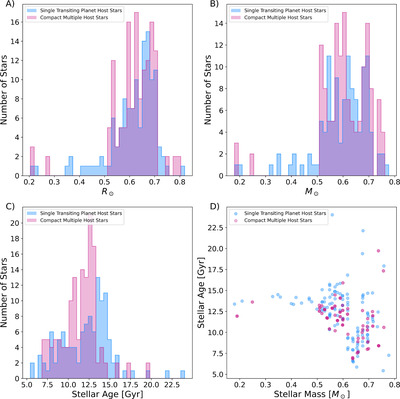
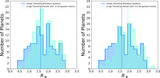
Caption: Figure 3.
(A) Overlaid histograms of stellar radii of single-transiting-planet host stars (blue) and compact multiple system host stars (pink). (B) Overlaid histograms of stellar mass of single-transiting-planet host stars (blue) and compact multiple system host stars (pink). (C) Overlaid histograms of stellar age of single-transiting-planet host stars (blue) and compact multiple system host stars (pink). The uncertainty on the stellar ages used are immense. (D) Stellar age vs. stellar mass for host stars of single-transiting planetary (blue) and compact multiple systems (pink). Most of our stellar sample host stars have stellar radius values between 0.5 R ☉ and 0.7 R ☉ and stellar mass values between 0.5 M ☉ and 0.7 M ☉ with a tail toward smaller masses and radii. The single-transiting planetary systems and the compact multiples do not have significantly different stellar parameters, and derived differences in the planetary samples are unlikely to be a consequence of their host star population.
Other Images in This Article
Copyright and Terms & Conditions
© 2024. The Author(s). Published by the American Astronomical Society.

