

Image Details
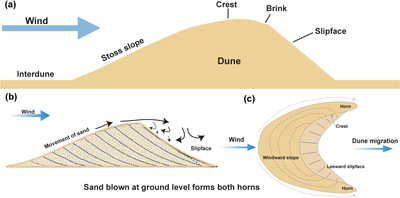
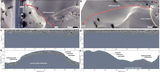
Caption: Figure 5.
Conceptual model linking dune morphology, aeolian accretion, and GPR-imaged internal architecture. (a) Cross-sectional morphology of a representative dune under the prevailing wind, showing the principal geomorphic elements, including the stoss slope, dune crest, and lee slope. Wind-driven sand transport carries grains up the stoss slope; after crossing the crest, grains are deposited on the lee side through grainfall, grainflow, and avalanching. (b) Conceptual model of dune internal architecture, illustrating inclined accretion surfaces, cross-bedding, and stage-bounding surfaces formed during dune migration. Variations in grain-size distribution, compaction, pore structure, or moisture content between adjacent depositional layers can produce weak dielectric contrasts and generate detectable internal reflectors in GPR profiles. (c) Schematic plan view of a barchan dune, showing the stoss slope, slipface, horns, and migration direction. Surface morphology, prevailing wind direction, and internal accretion architecture together govern the reflection geometries observed in radar profiles.
Other Images in This Article
Copyright and Terms & Conditions
© 2026. The Author(s). Published by the American Astronomical Society.

