

Image Details
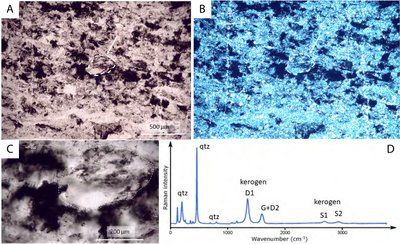
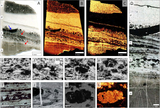
Caption: Figure C2.
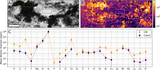
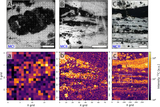
The context and details of clast in Figures 5(F) and 7(A) within a heterogeneous mass of pseudomorphed volcanoclastic material and carbonaceous matter (CM). (A), (B) Plane and polarized light micrographs of the sediment showing the location of the target clast. Only two components occur in this sediment, quartz (hereafter qtz; translucent in (A), blue in (B)) and carbonaceous matter (black in both). The outline of an oval clast is highlighted by a dotted white line and a white arrow. The shape of the clast is suggestive of a volcanic spherule. (C) Detail of the carbonaceous matter forming a spicular texture around the spherule. (D) The average Raman spectrum of the area displayed in (A) and (B) showing the Raman bands of qtz at 126, 204, 260, 354, 397, 465, 697, 807, 1081, and 1162, and the D1 at 1350 cm−1, the G+D2 at 1600 cm−1, the S1 at 2689 cm−1, and the S2 at 2939 cm−1, first- and second-order Raman bands of kerogen. Given the hydrothermal influence on these particular sediments (documented by the Eu signature, F. Westall et al. 2026, in preparation), it is to be expected that at least some fraction of the CM in the sediment could be of hydrothermal origin. In this sense, it could be argued that the CM coatings around the volcanic particles may be of hydrothermal origin. The question here is, by what process would hydrothermal CM coat the volcanic particles in such a manner as to form an irregular, relatively thick, 3D coating. (Note the images here are planar sections through the sediment and do not demonstrate that the coating is 3D. The thin section is 30 μm thick, and the coating can be observed throughout this thickness.) Our hypothesis, based on geochemical evidence of coatings on other volcanic particles in this sediment (F. Westall et al. 2015b; K. Hickman-Lewis et al. 2020) and in similar volcanoclastic sediments in the similarly aged 3.45 Ge Kitty’s Gap Chert, Pilbara, Australia (F. Westall et al. 2025), is that this coating was created by colonies of chemotrophic microorganisms that inhabited the nutrient-rich sediments.
Other Images in This Article
Show More
Copyright and Terms & Conditions
© 2026. The Author(s). Published by the American Astronomical Society.

