

Image Details
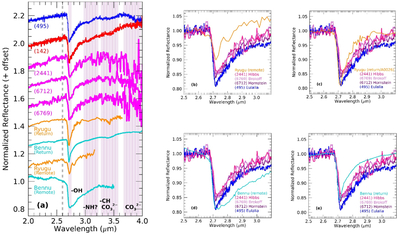
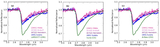
Caption: Figure 9.
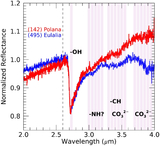
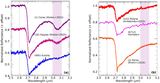
(a) Offset comparison between the JWST spectral repository of PEC asteroids ((495) Eulalia = blue; (142) Polana = red (A. Arredondo et al. 2025); Polana family objects = magenta), Bennu (turquoise; V. E. Hamilton et al. 2019; D. S. Lauretta et al. 2024), and Ryugu (orange; K. Kitazato et al. 2019; C. Pilorget et al. 2022; see also T. Yada et al. 2022; T. Nakamura et al. 2023). Both the remote, spacecraft spectra and the returned-sample spectra are presented for Bennu and Ryugu. All spectra are normalized to 1 at 2.6 μm (by the vertical dashed line (gray), with offset increments of 0.15 in reflectance for clarity. Each spectrum shows a feature centered around 2.72 μm, as referenced by the light purple regions. (142) Polana, (495) Eulalia, the retuned samples from both NEAs, and the remote spectrum of Bennu also exhibit minor absorptions longward of 2.72 μm, also referenced by the light purple regions. (b) Overlapping comparison between SAMBA-3 PEC targets and Ryugu’s NIRS3 spectrum (K. Kitazato et al. 2019), (c) Ryugu’s A0026 sample spectrum (C. Pilorget et al. 2022; see also T. Yada et al. 2022; T. Nakamura et al. 2023), (d) Bennu’s globally averaged spectrum (V. E. Hamilton et al. 2019), and (e) Bennu’s averaged sample spectrum (D. S. Lauretta et al. 2024). Normalization and color coding remain the same throughout (a)–(e).
Other Images in This Article
Show More
Copyright and Terms & Conditions
© 2026. The Author(s). Published by the American Astronomical Society.

