

Image Details
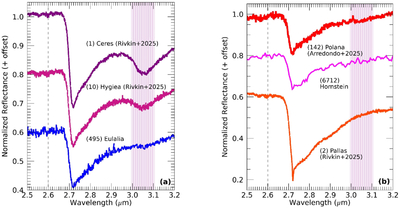
Caption: Figure 10.
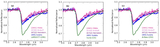
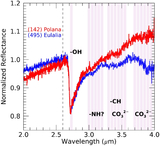
Spectral comparison of the 2.6–3.2 μm region among main-belt asteroids (a) (1) Ceres (purple), (10) Hygiea (medium dark violet), and 495 Eulalia (blue), which show “sharp”-type 2.7 μm bands and various depths in their absorptions around 3.0–3.2 μm. (b) (142) Polana (red), (6712) Hornstein (magenta), and (2) Pallas (orange red) also show sharp-type 2.7 μm bands, but lack appreciable absorptions in the 3.0–3.2 μm range (A. Arredondo et al. 2025; A. S. Rivkin et al. 2025). Given their overall similarities in the 3.0–3.2 μm range, we do not show the other 2 PFAs in this work for the sake of space. Spectra below (1) Ceres and (142) Polana are offset in reflectance increments of 0.2, and a vertical, dashed, gray line highlights the normalization wavelength of 2.6 μm.
Other Images in This Article
Show More
Copyright and Terms & Conditions
© 2026. The Author(s). Published by the American Astronomical Society.

