

Image Details
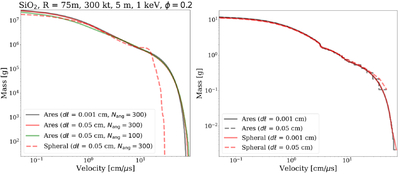
Caption: Figure 7.
Left: the cumulative mass ablated from the asteroid as a function of velocity for 2D-axisymmetric Ares vs. 3D Spheral simulations, i.e., ∑imi(vi > v). The x-axis indicates the minimum velocity considered, and this distribution function indicates how much material is moving at that velocity or higher in our models. We show curves from the same Ares and Spheral simulations from Figure 6 at 0.05 cm resolution. 3D Spheral results are qualitatively similar to Ares for material moving at speeds v ≲ 10 cm μs−1 but do not produce material with speeds exceeding 30 cm μs–1. These differences are largely driven by resolution discrepancies between the 3D models in Spheral and the 2D models in ARES, as the fastest material results from the extremely thin layer of mass right at the surface of the asteroid, and also explain the differences in the blow-off momentum curves in Figure 6. Right: 1D comparisons at dℓ = 0.001 cm and dℓ = 0.05 cm resolution in Ares and Spheral agree well on the mass distribution as a function of velocity.
Other Images in This Article
Show More
Copyright and Terms & Conditions
© 2026. The Author(s). Published by the American Astronomical Society.

