

Image Details
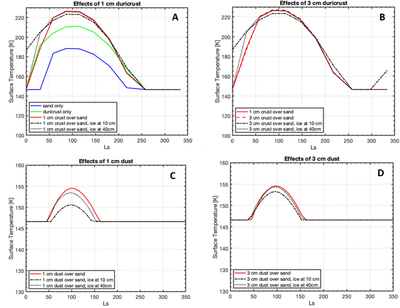
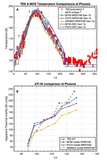
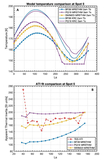
Caption: Figure 14.
Seasonal temperature curves calculated via MARSTHERM illustrate the capacity of thin layers of duricrust (a), (b), and dust (c), (d) to mask the presence of underlying ice in scenarios with three-material layers. Note that 1–3 cm thick layers of duricrust are plausible given in situ observations of up to 5–10 cm thick duricrust layers (M. Golombek et al. 2020). A 1 cm surface layer of duricrust can effectively conceal ice at only 10 cm depth (a). A 1 cm surface layer of dust is less effective at concealing underlying ice; however, a 3 cm dust layer makes ice detection marginal at 10 cm depth, and fully masks ice at 40 cm depth.
Other Images in This Article
Show More
Copyright and Terms & Conditions
© 2026. The Author(s). Published by the American Astronomical Society.

