

Image Details
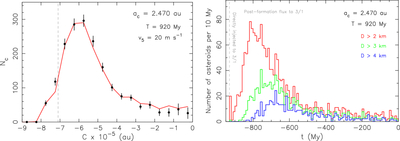
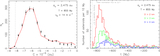
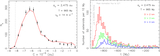
Caption: Figure 10.
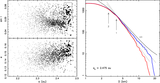
Modeling the dynamical evolution of the Eulalia family with the center ac = 2.47 au, more distant from the J3:1 than our canonical choice. The vertical dashed line in the left panel shows the C⋆-value, though our data (black symbols with formal uncertainties) continue formally farther due to finite bin size and a limited mobility population of objects in the bin containing the C⋆-value. This solution used the bulk density ρ = 1.5 g cm−3, the surface thermal inertia Γ = 200 SI units, and the variable YORP timescale τ0 = 1 My. The best match to the data (left panel) is obtained for T = 920 My and v5 = 20 m s−1 (recall that the characteristic initial ejection velocity is vej(D) = v5 (5 km/D) in meters per second). Here, a larger initial distance from the J3:1 is partially compensated by a higher initial ejection velocity if compared to the solution shown in Figure 9. The total number of transported fragments to the J3:1 is only modestly smaller than in solutions shown in Figures 8 and 9. Both ordinates are calibrated to the adopted family identification without correcting for its incompleteness.
Other Images in This Article
Show More
Copyright and Terms & Conditions
© 2026. The Author(s). Published by the American Astronomical Society.

