

Image Details
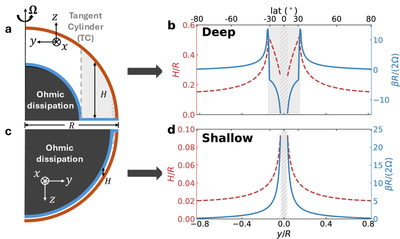
Caption: Figure 2.
Geometry of the atmosphere on giant planets and the corresponding β profile. The upper row shows the deep scenario (D = 0.15 R, (a) and (b)), and the lower row shows the shallow scenario (D = 0.02 R, (c) and (d)), where D is the jet penetration depth and R is the planetary radius. In the schematics (a) and (c), the black shaded region indicates areas where jets are damped by ohmic dissipation. The column depth H is defined as the distance from the surface (brown line) to the bottom, marked by the ohmic dissipation level inside the TC and a virtual equatorial plane outside the TC (blue line). The gray dashed line indicates the TC, where the cylindrical air column contacts the ohmic dissipation layer. The light gray shading indicates regions outside the TC. The gray hatched region marks the area excluded from our simulation domain to avoid the singularity at the equator. Inside the TC, H decreases with latitude and β is positive, whereas outside the TC, H increases with latitude and β becomes negative. All values in (b) and (d) are nondimensionalized using planetary radius and rotation (see Appendix A for a detailed derivation).
Other Images in This Article
Show More
Copyright and Terms & Conditions
© 2026. The Author(s). Published by the American Astronomical Society.

