

Image Details
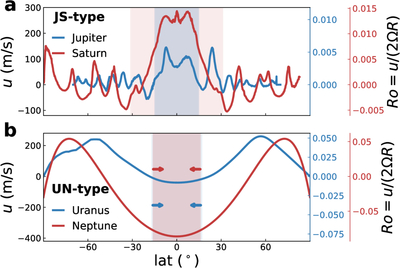
Caption: Figure 1.
Observed surface zonal wind profile on giant planets. The JS-type jets are shown in (a) and the UN-type jets are shown in (b). The shaded regions indicate regions outside the tangent cylinder (TC), with blue representing Jupiter in (a) and Uranus in (b), and red representing Saturn in (a) and Neptune in (b). For Uranus and Neptune, the TC latitude is less well constrained, and we adopt the upper-limit estimate from Y. Kaspi et al. (2013). The Rossby number of the flow, Ro = U/(2ΩR) where U is the velocity, Ω is the rotation rate, and R is the planetary radius, is also shown. For Jupiter, data were obtained from Juno’s third perijove pass on 2016 December 11 (J. Tollefson et al. 2017). For Saturn, measurements were taken from Cassini Imaging Science Subsystem Continuum Band 2 and Continuum Band 3 images spanning 2004–2008 (E. García-Melendo et al. 2011), corrected with the rotation rate in R. Helled et al. (2015). For Uranus and Neptune, due to limited observations, fitted curves are used, based on L. Sromovsky et al. (2015) and L. A. Sromovsky et al. (1993), respectively.
Other Images in This Article
Show More
Copyright and Terms & Conditions
© 2026. The Author(s). Published by the American Astronomical Society.

