

Image Details
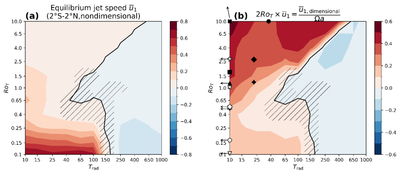
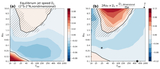
Caption: Figure 5.
Equilibrium equatorial jet speed in tidally locked planets. (a) Upper-level zonal-mean zonal wind speed ﹩\overline{{u}_{1}}﹩ averaged 2∘S–2∘N, as a function of RoT and Trad. (b) Same as panel (a), multiplied by 2RoT. In both panels, the hatched region marks simulations for which ﹩\overline{{u}_{1}}﹩ switches sign more than 10% of the time in the last 700 rotation periods of the simulation. The thick black line marks the transition from superrotation to subrotation. In panel (b), filled symbols show approximate parameters for known tidally locked terrestrial planets: GJ1132b (square), LHS 1140 b (cross), Trappist 1b (plus sign), Trappist 1 c (diamond), Trappist 1d (circle), 55 Cancri e (downward-pointing triangle), Kepler 10b (upward-pointing triangle). Open symbols show approximate parameters for known hot Jupiters: HD 189733b (squares), HD 209458b (cross), HD 149026b (plus sign), HAT-P-7b (diamond), WASP-18b (circle), WASP-12b (downward-pointing triangle). Planets that fall outside of the regime diagram are brought to the nearest value; arrows are used to indicate planets for which Trad < 5 or RoT > 20. See Appendix D for details on the parameters and estimation.
Other Images in This Article
Show More
Copyright and Terms & Conditions
© 2026. The Author(s). Published by the American Astronomical Society.

