

Image Details
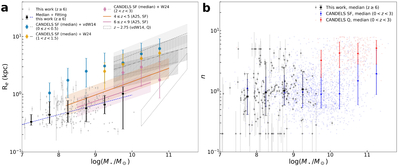
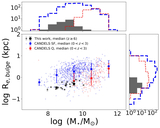
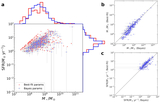
Caption: Figure 4.
Comparing galaxy structure at z ≥ 6 with previous studies spanning from high-z to the local Universe. (a) The rest-frame optical size–mass (M⋆−Re) relation. Gray points denote individual galaxies in our sample, with sizes derived from single-Sérsic modeling, while black hexagons represent stellar-mass-binned medians. For visual clarity, we show medians for star-forming (SF) galaxies in CANDELS at 0 ≤ z < 0.5, 1 ≤ z < 1.5, and 2 ≤ z < 3. The dashed blue curve represents the best-fit relation through the median values of Re at z ≥ 6. We overlay the established optical size–mass relations for SF galaxies at z ∼ 0.5 (vdW14; A. van der Wel et al. 2014), 1 < z < 1.5, 2 < z < 3 (W24; E. Ward et al. 2024), 4 ≤ z < 5, and 6 ≤ z < 9 (A25; N. Allen et al. 2025), as well as quiescent galaxies at z ∼ 2.75 (vdW14,Q; A. van der Wel et al. 2014). The associated 1σ scatter of the relations is indicated by shaded and dashed-box regions. (b) A comparison of rest-frame optical Sérsic index (n) distributions. Most galaxies in the z ≥ 6 sample (gray points and black medians) exhibit a distribution consistent with low-n values, similar to CANDELS SF galaxies at z < 3 (blue individual points and medians). The red symbols represent individual and median values for CANDELS quiescent (Q) galaxies. In both panels, error bars on individual points represent 1σ uncertainties, while error bars on median values denote the 16th and 84th percentiles of the distribution within each bin. We used a minimum threshold of 10 data points (5 for z ≥ 6 galaxies, owing to the smaller sample size) per mass bin to calculate medians.
Other Images in This Article
Copyright and Terms & Conditions
© 2026. The Author(s). Published by the American Astronomical Society.

