

Image Details
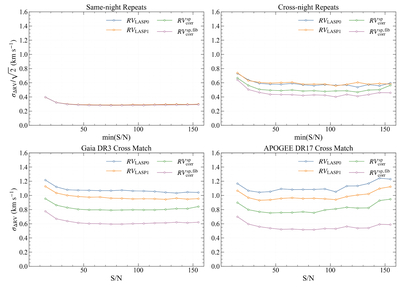
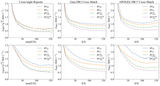
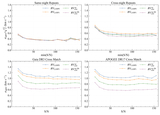
Caption: Figure 5.
Residual scatter versus LAMOST MRS S/N in four validation tests. From left to right and top to bottom, panels show same-night repeats, cross-night repeats, residuals relative to the Gaia DR3–corrected RVs, and residuals relative to APOGEE DR17. Curves show RVLASP0 (blue), RVLASP1 (orange), ﹩{\rm{R}}{{\rm{V}}}_{{\rm{corr}}}^{{\rm{sp}}}﹩ (green), and ﹩{\rm{R}}{{\rm{V}}}_{{\rm{corr}}}^{{\rm{sp}},{\rm{fib}}}﹩ (purple). In each S/N bin, we estimate σ by fitting a Gaussian to the core of the residual distribution, applying iterative 3σ clipping until convergence. For repeat observations, σ is measured from pairwise RV differences for the same source (binned by the lower S/N) and divided by ﹩\sqrt{2}﹩ to report the single-observation RV precision. For Gaia/APOGEE, σ is computed from LAMOST–reference RV differences in S/N bins of width 10 (for Gaia, rv_gaiadr3_err< 0.5 km s−1) and is not divided because it includes only small external-reference uncertainties. The two-level correction improves both repeatability and external consistency, with the largest gains in cross-night and external-reference tests.
Other Images in This Article
Show More
Copyright and Terms & Conditions
© 2026. The Author(s). Published by the American Astronomical Society.

