

Image Details
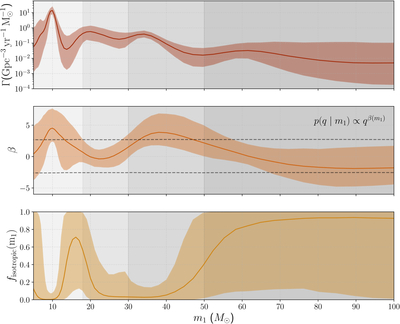
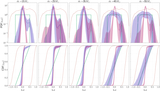
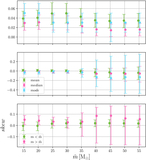
Caption: Figure 1.
Top panel: Γ is the astrophysical/source-frame merger-rate density per unit primary mass as a function of primary mass m1. Middle panel: inferred slope β(m1) of the conditional mass-ratio distribution, ﹩p(q| {m}_{1})\propto {q}^{\beta ({m}_{1})}﹩, obtained using our Gaussian-process population model. The dashed lines in this panel are the 90% confidence bands of the prior on β(m1). Bottom panel: inferred mixing fraction of an isotropic-spin population from the LVK analysis ( LIGO Scientific Collaboration et al. 2026b), based on a model in which the χeff distribution is described as a mixture between a Gaussian component and a broad uniform component, with the mixing fraction modeled as a Gaussian process as a function of mass. Vertical shaded bands indicate the mass intervals discussed in the text. Colored shaded regions show 90% intervals, while the solid lines are the inferred median. Here, we set ﹩({\tilde{m}}_{{\rm{low}}},\,{\tilde{m}}_{{\rm{high}}})=(50,\,200){M}_{\odot }﹩. However, the mass and q distributions shown here were found to be independent of the choice for these parameters.
Other Images in This Article
Copyright and Terms & Conditions
© 2026. The Author(s). Published by the American Astronomical Society.

