

Image Details
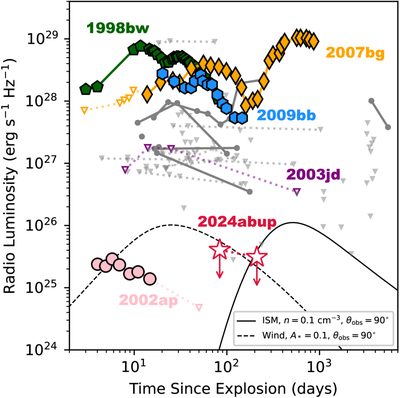
Caption: Figure 11.
Radio light curve of SN 2024abup at frequencies shown in Table C1, shown alongside other well-studied SN Ic-bl for comparison: 1998bw (S. R. Kulkarni et al. 1998); 2002ap (E. Berger et al. 2002); 2003jd (A. M. Soderberg et al. 2006); 2007bg (P. Salas et al. 2013); 2009bb (A. M. Soderberg et al. 2010); detections and upper limits of several other SNe are from A. Soderberg (2007), A. Corsi et al. (2023), and G. Schroeder et al. (2025). The solid and dashed curves show the expected 6 GHz light curves generated using VegasAfterglow (Y. Wang et al. 2026) for a typical relativistic jet with energy Eiso = 1051 erg, initial Lorentz factor Γ0 = 102, jet opening angle θj = 0.2, electron power-law index p = 2.3, and microphysical parameters ϵe = 0.1 and ϵB = 0.01. The solid curve assumes an ISM-like CSM with density n = 0.1 cm−3, while the dashed curve assumes a wind-like medium with A* = 0.1, both for a maximally off-axis viewing angle of θobs = 90∘. Our nondetections rule out these typical GRB-like jet models for any viewing angle more on-axis than θobs = 90∘, implying that any relativistic jet in SN 2024abup if present, must be either less energetic than standard GRB jets or propagating through a significantly lower-density environment.
Other Images in This Article
Show More
Copyright and Terms & Conditions
© 2026. The Author(s). Published by the American Astronomical Society.

