Image Details

Choose export citation format:

JWST Observations of SN 2024abup: First Detection of CO in a Broad-lined Type Ic Supernova and Constraints on r-process Nucleosynthesis

  • Authors: Manisha Shrestha, Lindsey A. Kwok, David J. Sand, Stan Barmentloo, Collin Christy, Anders Jerkstrand, K. Azalee Bostroem, Jennifer E. Andrews, Kate D. Alexander, Yize Dong, 一泽 董, C. E. Fields, Emily Hoang, Griffin Hosseinzadeh, Brian Hsu, Daryl Janzen, Saurabh W. Jha, Joel Johansson, Jeniveve Pearson, M. J. Lundquist, Darshana Mehta, Aidan Martas, Maryam Modjaz, Bernhard Müller, Conor L. Ransome, Aravind P. Ravi, Mathieu Renzo, Nicolás Meza Retamal, Bhagya Subrayan, Nathan Smith, Stefano Valenti, Sergiy Vasylyev, Giacomo Ricigliano, Peter J. Brown, Moira Andrews, Joseph Farah, D. Andrew Howell, Curtis McCully, Megan Newsome, Kathryn Wynn, Ryan Chornock, Natalie LeBaron, Raffaella Margutti, Melissa Shahbandeh, Chris Ashall, Peter Hoeflich

Manisha Shrestha et al 2026 The Astrophysical Journal Letters 1009 .

  • Provider: AAS Journals

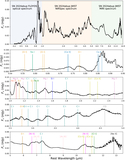
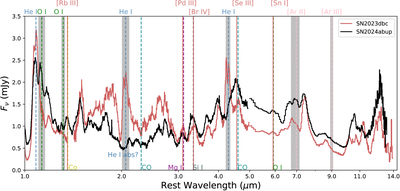
Caption: Figure 9.

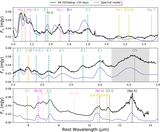
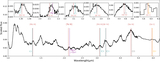
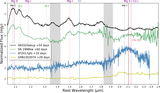
Comparison of the JWST NIR + MIR spectra of SN  (+41 days) and SN Ic 2023dbc (+36 days) (M. Shahbandeh et al. 2023). Major lines that are different between the two are shown in shaded gray regions. Lines from light and heavy species are indicated by dashed and solid lines, respectively. One of the major differences is the presence of prominent He I features in SN 2023dbc, which are absent in the case of SN 2024abup. Additionally, we detect O I lines in SN 2024abup, which are not present in SN 2023dbc. The CO feature in SN 2024abup is more prominent than in SN 2023dbc.

Other Images in This Article
Show More

Copyright and Terms & Conditions

Additional terms of reuse