

Image Details
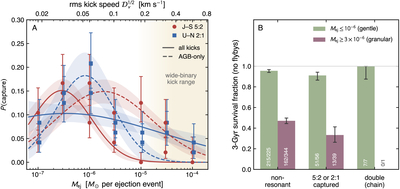
Caption: Figure 5.
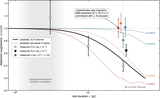
Stochastic resonant capture and its consequences. Panel (A): capture probability into the Jupiter–Saturn 5:2 and Uranus–Neptune 2:1 resonances versus Mej (Wilson 68% intervals; both variants); the upper axis converts Mej to the rms diffusion-equivalent recoil under the independent-event assumption (all-phases schedule), the shaded region marks ejection masses for which that recoil falls within the observationally permitted wide-binary range, and the smooth curves are log-normal profiles in ﹩\mathrm{log}{M}_{{\rm{ej}}}﹩ fitted to each series to guide the eye, with shaded 1σ fit-uncertainty bands. Panel (B): three-Gyr survival by resonant class in the gentle (Mej ≤ 10−6 M⊙) and granular (Mej ≥ 3 × 10⁻⁶ M⊙) regimes; double-resonant systems persist in the gentle regime (the sole granular double-resonant system is disrupted, 0/1), while in the granular regime captured systems show a ∼1.8σ survival deficit relative to nonresonant ones, consistent with a near-separatrix deposition.
Other Images in This Article
Copyright and Terms & Conditions
© 2026. The Author(s). Published by the American Astronomical Society.

