

Image Details
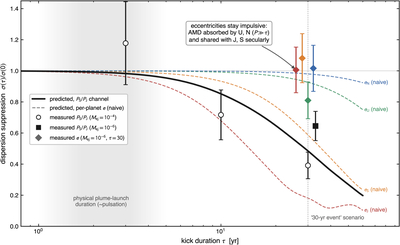
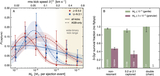
Caption: Figure B2.
Validity of the impulsive-kick approximation. Suppression of kick-driven dispersions when each recoil is spread over a duration τ (train of ten sub-impulses), relative to instantaneous kicks with identical realizations. The solid curve shows the predicted transfer-function suppression for the Jupiter–Saturn period-ratio random walk, weighted over the ejection-event schedule; measured values (black points; Mej = 10−4 and 10−6 M⊙) follow it. Dashed curves show the corresponding naive per-planet predictions for the eccentricity dispersions; the measured eccentricity dispersions (colored diamonds, τ = 30 yr; offset horizontally for visibility) instead remain at unity, because angular-momentum-deficit excitation is dominated by Uranus and Neptune—for which any plausible event duration is deeply impulsive (P ≫ τ)—and is redistributed to Jupiter and Saturn through secular coupling. Physically motivated event durations (shaded band) lie far inside the impulsive regime for all channels.
Other Images in This Article
Copyright and Terms & Conditions
© 2026. The Author(s). Published by the American Astronomical Society.

