

Image Details
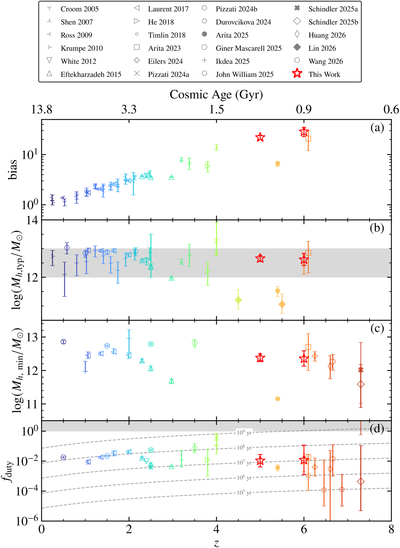
Caption: Figure 5.
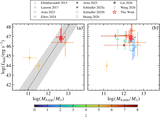
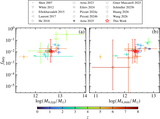
The bias parameters (a), the typical DMH mass (b), the minimum DMH mass (c), and the duty cycle (d) based on clustering analyses from z ∼ 0 to z ∼ 7.3. The quasar results (hollow points) are extracted from S. M. Croom et al. (2005), Y. Shen et al. (2007), N. P. Ross et al. (2009), M. Krumpe et al. (2010), M. White et al. (2012), S. Eftekharzadeh et al. (2015), P. Laurent et al. (2017), W. He et al. (2018), J. D. Timlin et al. (2018), J. Arita et al. (2023), A.-C. Ďurovčíková et al. (2024), A.-C. Eilers et al. (2024), E. Pizzati et al. (2024a, 2024b), H. Ikeda et al. (2025), M. Giner Mascarell et al. (2025), J.-T. Schindler et al. (2026), A. John William et al. (2026), J. Huang et al. (2026), F. Wang et al. (2026), and this work. The AGN and LRD results (filled points) are extracted from J. Arita et al. (2025), X. Lin et al. (2026), and J.-T. Schindler et al. (2025), respectively. Gray shaded areas denote: (b) the typical DMH mass range of quasars; (d) the physically forbidden region for fduty.
Other Images in This Article
Copyright and Terms & Conditions
© 2026. The Author(s). Published by the American Astronomical Society.

