

Image Details
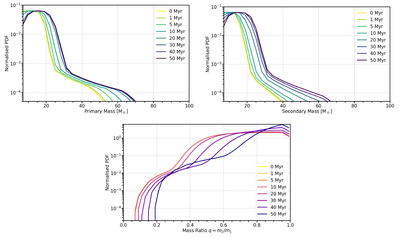
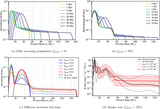
Caption: Figure 4.
Time evolution of binary populations including enhanced accretion onto the secondary companion. The calculations are identical to those shown in Figure 3, except that the secondary experiences the density enhancement associated with the common-accretion regime following A. Rosselli-Calderon et al. (2026). The panels show the evolution of the primary-mass distribution (top left), secondary-mass distribution (top right), and mass-ratio distribution (bottom). In contrast to the isolated-accretion case, the enhanced growth of the secondary drives the mass-ratio distribution toward q ≃ 1, causing the binary population to evolve toward increasingly equal-mass systems. The comparison with Figure 3 demonstrates that the partitioning of accreted gas between the binary components plays a crucial role in determining the properties of the resulting population.
Other Images in This Article
Copyright and Terms & Conditions
© 2026. The Author(s). Published by the American Astronomical Society.

