

Image Details
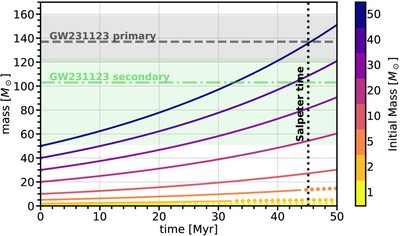
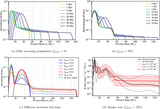
Caption: Figure 1.
Illustration of accretion-driven transport in mass space for the accretion regimes described above, where the accretion rate is taken to be the minimum between the three regimes. Solid lines represent accretion in the Eddington regime, and “+” markers represent accretion in the BHL regime. Different colors show the evolution of compact objects with different initial masses under the fiducial gas-rich conditions adopted in this work. The calculations assume a local gas density of 7 × 10⁻¹⁶ g cm−3 and a gas lifetime of τgas = 10 Myr, representative of conditions at r = 0.1 pc in an AGN disk surrounding a 107 M⊙ supermassive black hole. Because the accretion rate remains mass dependent, more massive objects evolve more rapidly than lower-mass objects, providing a concrete example of the differential growth discussed in Section 2. The dashed and dotted–dashed horizontal lines indicate the primary and secondary masses inferred for GW231123, while the shaded regions denote the corresponding uncertainties.
Other Images in This Article
Copyright and Terms & Conditions
© 2026. The Author(s). Published by the American Astronomical Society.

