

Image Details
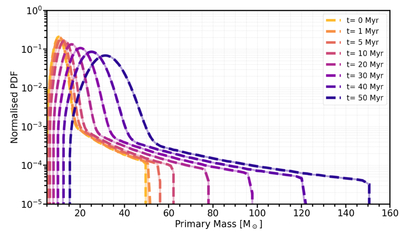
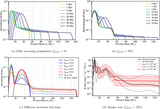
Caption: Figure 2.
Evolution of the normalized primary-mass distribution under sustained gas accretion. The initial population consists of a Salpeter-like power law combined with a Gaussian component centered at μ = 10 M⊙, with masses drawn between 5 and 50 M⊙. The gas density evolves as ﹩{\rho }_{g}(t)=7\times 1{0}^{-16}\exp (-t/{\tau }_{{\rm{gas}}})\,{\rm{g}}\,{{\rm{cm}}}^{-3}﹩ with τgas = 10 Myr. Different colors show the mass function at successive times. Solid curves correspond to Monte Carlo calculations and dashed curves to the analytical solutions derived using the continuity-equation framework. The distribution broadens and extends toward higher masses as accretion drives objects through mass space at mass-dependent rates.
Other Images in This Article
Copyright and Terms & Conditions
© 2026. The Author(s). Published by the American Astronomical Society.

