

Image Details
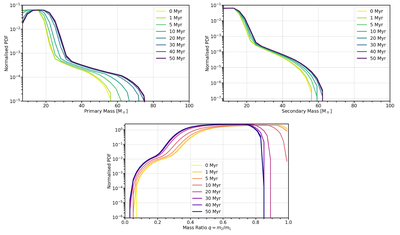
Caption: Figure 3.
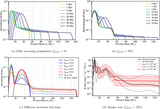
Time evolution of binary populations in the absence of secondary accretion enhancement, i.e., ﹩{\dot{m}}_{2}={q}^{2}/{(1+q)}^{2}\dot{M},\,{\dot{m}}_{1}=(1+2q)/{(1+q)}^{2}﹩, m2 accretes as isolated and m1 completes to the total expected common-accretion rate, according to the relevant regime. The calculations are based on Monte Carlo simulations with 5 × 10⁶ realizations, assuming an initial gas density of ρg,0 = 10−18 g cm−3 and a binary separation of 0.1 au. The panels show the evolution of the primary-mass distribution (top left), secondary-mass distribution (top right), and mass-ratio distribution (bottom). Although both components grow through gas accretion, the more massive object accretes preferentially, causing the mass-ratio distribution to shift toward smaller values of q. In this limit, accretion amplifies the initial mass asymmetry between binary companions.
Other Images in This Article
Copyright and Terms & Conditions
© 2026. The Author(s). Published by the American Astronomical Society.

