

Image Details
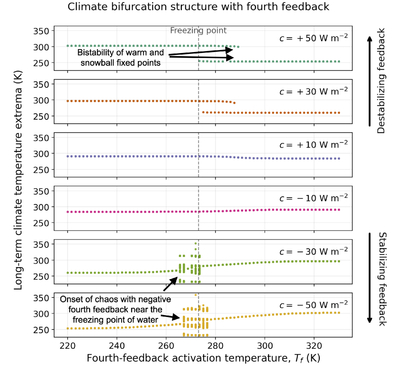
Caption: Figure 3.
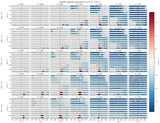
Bifurcation structure of the four-feedback climate model as a function of feedback transition temperature (Tf) and feedback strength (c). Each panel shows a sweep in Tf for a fixed value of c. For each (c, Tf) combination, the model was integrated from 10 random initial conditions generated independently for each parameter combination; the plotted points are the local temperature maxima and minima recorded after the transient evolution was removed. Single branches indicate convergence toward a stable equilibrium, whereas multiple extrema at the same Tf indicate periodic or chaotic variability. The dashed vertical line marks the freezing point of water (273 K). Strong negative feedbacks (c ≲ −30 W m−2) generate complex dynamics when the feedback activates near the ice–albedo transition, while weaker feedbacks generally converge to stable climates. Strong positive feedbacks (c = +30 to +50 W m−2) produce bistability between warm and snowball-like states.
Other Images in This Article
Copyright and Terms & Conditions
© 2026. The Author(s). Published by the American Astronomical Society.

